
Channel Leaders Confront AI's 'Trilemma': The Intersection of Infrastructure, Cost, and Virtualization Strategy
At the annual Channel Partners Conference & Expo in Las Vegas last week, AI anecdotes were everywhere. Behind narratives of coding heroism, productivity breakthroughs, and recurring revenue streams, partners are struggling with persistent IT readiness gaps that undermine adoption efforts. Expedient CEO Bryan Smith summarized this challenge as a 'trilemma': 80% of companies need to redo hardware and infrastructure, 70% seek to cut hyperscaler cloud spending, and nearly 100% are reassessing virtualization strategies.
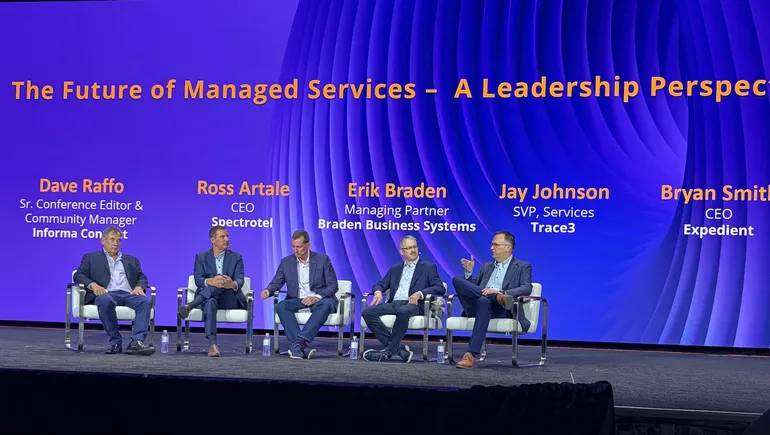
At last week's annual Channel Partners Conference & Expo in Las Vegas, AI was a hot topic. Behind the narratives of coding heroics, productivity breakthroughs, and recurring revenue streams, partners are grappling with stubborn IT readiness gaps that undermine adoption efforts.
"Currently, 7 out of 10 conversations we have with the C-suite are clearly centered on the AI paradigm—and their struggles with it," said Eric Braden, managing partner at Braden Business Systems, during the opening panel of the event's MSP Summit. "Everything needed to run a good AI implementation, adoption, and outcomes strategy, main street businesses cannot do alone. We have a huge opportunity to be their quarterback."
According to Gartner data, IT services remain the largest segment of global IT spending, accounting for $1.7 trillion of the over $5.5 trillion market last year. This year, that segment is expected to represent 30% of global spending, with the market growing 10.8% to $6.15 trillion, the analyst firm said in February. As AI technology becomes more prevalent, demand for AI services will grow by about 40%, approaching $600 million.
"Board and CEO conversations start with 'Oh, give me some AI,' and then their teams are responsible for implementation," said Bryan Smith, CEO of Expedient. "The biggest challenge we see is adoption and usage, because simply rolling something out without empowering the team often yields poor results."
Top-down demand is accelerating the deal process. According to Smith, at Expedient, an MSP focused on cloud, data center, and resiliency services, the average AI services deal takes just one to two months from initial conversation to closing.
Despite executive enthusiasm, partners still face entrenched deployment obstacles that touch core technologies, many of which are familiar issues in the MSP industry.
"We really summarize it as what we call the 'trilemma,'" Smith said. "80% of companies need to redo hardware and infrastructure to properly leverage AI. About 70% are looking to cut hyperscaler cloud spending, while nearly 100% are reevaluating their virtualization strategies. All these factors converge into one decision because they are intertwined."
Expedient has taken steps to address these three challenges, recently launching a bridge program that provides VMware continuity and migration services for organizations reassessing their hypervisor after Broadcom's acquisition of the virtualization software vendor. The company deployed an AI governance platform and outcomes team in February.
"The core of our business is bringing security technologies together to simplify implementation and operations," Smith said. "AI is no exception."
Consultative capabilities—acting as a trusted advisor—have been key to Spectrotel's business acquisition. Spectrotel is a company that manages network services for enterprise-level and mid-market organizations.
"I think every CIO is discussing with their board and CEO how to accelerate learning and drive efficiency through their business, so it's a bit like the Wild West," said Ross Artale, CEO of Spectrotel. "Our view is that what they really need are analysts and thought leaders to provide business context for implementation."
The AI race is also spurring demand for network upgrades, as inference workloads continue to increase.
"Connectivity truly enables the adoption of cloud and AI," Artale said. "It is the ultimate enabler."