
Thrive CFO on How to Stand Out in a 'Fragmented' IT Market
Thrive's new CFO Matt Kosovsky recently sat down with CFO.com, discussing how his nearly decade-long experience at employee-owned private equity firm Berkshire Partners shaped his leadership style, as well as Thrive's positioning in the fragmented IT market. He highlighted the intensifying competition in the private equity industry, the complexity of integrating cybersecurity and AI, and offered career advice for young finance professionals.
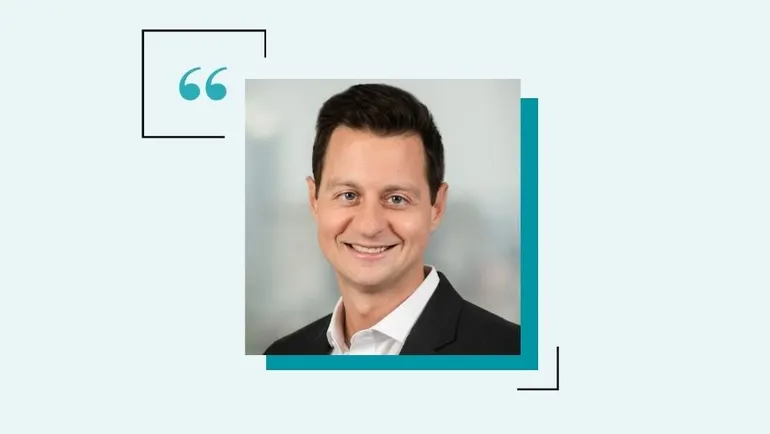
Matt KosovskyAfter nearly a decade in leadership roles at employee-owned private equity firm Berkshire Partners, he has finally landed a permanent CFO position. In January, he officially became chief financial officer of Thrive, an IT managed services and cybersecurity provider that was an investment of his former employer. Kosovsky, who started his career as an accountant at Deloitte, believes Thrive is at the forefront of "today's highly fragmented IT services market."
According to Kosovsky, the Massachusetts-based company has approximately 1,500 employees and annual revenue of about $400 million.
In an interview with CFO.com, Kosovsky discussed the intensifying competition in the current private equity landscape, his approach to cybersecurity in an increasingly complex tech world, and advice for young accounting and finance professionals.
Matt Kosovsky

Chief Financial Officer of Thrive
First CFO role: 2026
Key previous employers:
- Berkshire Partners
- Deloitte
Editor's note: This interview has been edited for length and clarity.
DAN NIEPOW:You joined Thrive in January after nearly a decade at Berkshire Partners. Can you talk about what it was like working at an employee-owned private equity firm?
MATT KOSOVSKY:Culturally, Berkshire Partners is a bit different from many private equity firms in the market. They emphasize a team-oriented approach in everything they do, whether it's transactions or internal operations. Compared to other private equity firms I've seen and interacted with, they are less top-down and more decentralized in decision-making.
Additionally, Berkshire maintains long-term relationships with its portfolio companies and their management teams. These relationships are crucial to the firm's culture and brand, and are a net advantage over the long term.
What insights did you gain about the current private equity industry during your time at Berkshire Partners?
The industry is highly competitive today. Through observation and my previous experience at Deloitte, I've witnessed the escalating competition in the industry. Whether it's competing for new investment capital, or for management teams and top talent, as more firms enter the market, competition only intensifies. This naturally compresses returns. Differentiation can't rely solely on financial engineering; in today's market, you have to bring other value to your investments.
Your role at Thrive is your first permanent CFO position. How did you know you were ready?
During my time at Berkshire, I had the opportunity to be embedded in portfolio companies on multiple occasions and served as interim CFO several times. So, I've sat in this seat in an interim capacity, seen how efficient finance functions operate, and gone through many difficult periods at portfolio companies.
I think I've seen a broader range of situations compared to other CFOs in the market who may have a more limited perspective.
In theappointment announcement, you mentioned the growing demand for "integrated cloud, cybersecurity, and AI services." How do you view balancing cybersecurity in the age of AI?
I'll first admit that I'm by no means an expert, but we have a very strong team focused on cybersecurity. I firmly believe that investing resources to stay ahead of the market in risk mitigation will continue to be an advantage for us.
If you look at the vendors and support functions in the market, we are quite ahead in terms of functional maturity and service integration—from cloud to managed services to cybersecurity. We're not only able to provide expert insights, but also guide customers through this challenging and turbulent period.
Thrive seems to be actively pursuing M&A, completing five deals last year and 27 since its founding. What factors do you consider when selecting acquisition targets?
The market remains very active. Acquisitions will continue to be part of our value creation plan, but we don't have a specific focus on a geographic region, industry vertical, product, or service line. We have an ideal customer profile, so we look for acquisition opportunities that fit and complement us, such as filling geographic gaps. These are the lenses we use when evaluating acquisitions.
What advice do you have for young people considering a career in finance or accounting?
I encourage everyone to stay flexible, keep trying new experiences, and take on new risks. From my entry-level role at Deloitte to where I am now, it was by no means a straight line. My experiences across different service lines and at Berkshire were all unexpected. Continuously adapting to your environment, seeking learning opportunities, challenging yourself, and accumulating new experiences will pay off in the long run.